
Thirunavaya Mahatmyam
Thirunavaya is one of the sacred places in Kerala among the 108 divine Vishnu sites across India. It is the oldest and most significant among Kerala’s Vishnu shrines.
The Navayogis (nine sages) traveling across India obtained a special Salagramam (sacred stone) from the Gandaki River with instructions to consecrate it at the most auspicious place. They selected the banks of the Bharathapuzha at Thirunavaya for the installation.
The first installation was done at this site. Later, another Salagramam was similarly found and consecrated here, and eventually, eight such consecrations were done, hidden beneath the earth. Young Karabhajan, reflecting on this, realized that the deity yet to be identified is Mukundan, the giver of liberation, and consecrated it accordingly.
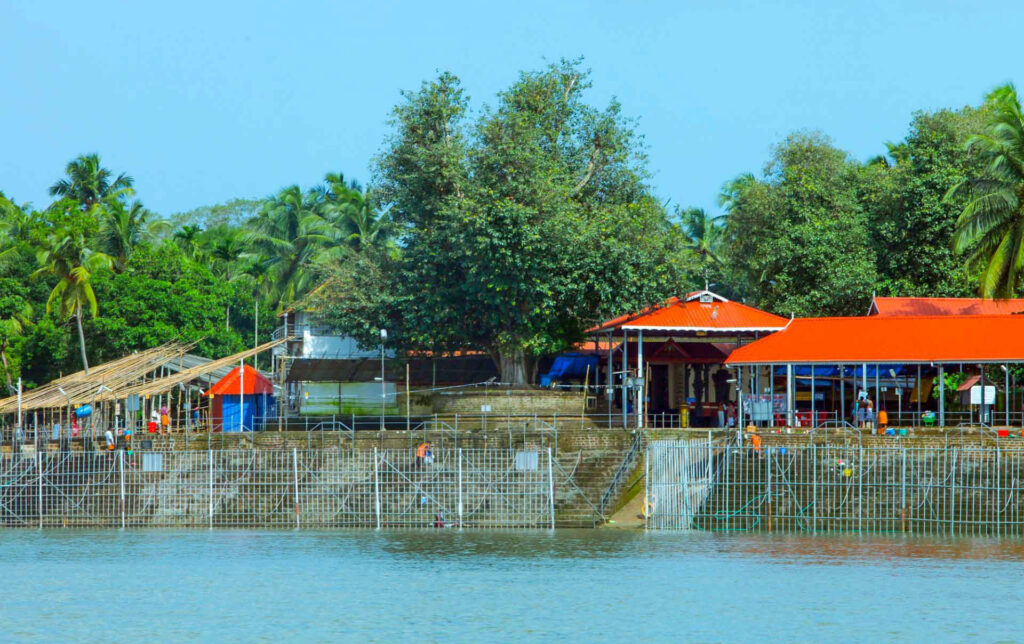
Rituals were established: water from the Bharathapuzha should be used for sacred ablutions, lotus flowers for offerings, lamps for illumination, and milk and rice pudding as food offerings.
It is believed that Sage Jamadagni performed Shraddha rituals for his ancestors here. Even today, devotees arrive at the banks of Bharathapuzha to perform Bali rites, offering salvation to departed ancestors.
The legend of Gajendra Moksha is closely associated with Thirunavaya, and here Gajendra is revered as Lord Ganapati. Mahalakshmi is the main deity, making this an extraordinary temple.
The Thirunavaya Mukundeshwara temple is on the northern bank of Bharathapuzha, while Brahma’s temple, consecrated by Brihaspati, is on the southern bank. Shiva’s temple is also nearby, forming a sacred triangle, with Rajarajeshwari at its center, overlooking Bharathapuzha.
Thirunavaya is thus a rare and sacred land where exceptional consecrations were performed. During Magha month, the natural rhythm of this holy place changes, and the powerful divine presence manifests. Participating in holy baths (Nila Snanam) and rituals during this time benefits individuals, communities, and the land itself.
The Land of Brahma’s Yajna
After creating the land of Kerala, Parashurama requested Brahma to conduct a yajna on this land to ensure its prosperity and wealth.
Brahma initially selected the Thirumoorthi Hill ranges in the Anamala region of the Sahya Mountains for the yajna. However, due to delays caused by the arrival of deities—including Saraswati (the yajamana’s consort), Lakshmi, Parvati, and Indra’s consort Shachi—the yajna could not proceed on time. The delayed deities flowed as rivers into Kerala.
Parashurama once again requested Brahma to find a suitable yajna land to continue the interrupted yajna. Brahma, after searching for the most auspicious place, reached Tapasanur—today known as Thavanur—along the banks of the Peraar River, which had formed from the deities who turned into rivers. This land, where the Saptarishis, the Navayogis, and numerous other sages had performed penance, was chosen as the yajna site.
Brahma conducted the yajna here during the auspicious month of Magha. All the deities, along with those from Tapasanur and Thirunavaya, gathered to participate. The seven sacred rivers, led by the Ganga Devi, brought all the rivers of India to this site. Thus, the Nila river became the Bharathapuzha.
During the Magha month, the divine presence of the deities who participated in the ancient yajna continues to bless every part of this land. Moreover, the sacred rivers from across India merge here in the Bharathapuzha.
Sages confirm that visiting Thirunavaya in Magha, performing darshan, bathing in the holy waters, participating in satsangs, performing pujas, chanting, and meditating are highly auspicious and spiritually rewarding.
The Importance of Holy Bathing (Punyasnana)
Due to the unique positions and alignments of planets in their celestial movements, at certain times and in specific locations, extraordinary divine energies arise in nature.
The first and foremost receivers of these changes in nature are the sacred sites themselves. In rivers imbued with divine presence from birth, this energy shift is especially strong.
When a person comes to such a sacred site during this time and takes a holy bath, the divine energy awakened in nature also manifests within the individual. According to scriptures, everything in the universe, including the physical body, is capable of receiving this influence.
Thus, when the individual returns to their homeland with the received divine presence, the deity’s blessings manifest in their mind, their land, and their sphere of actions. When someone absorbs this self-manifested divine energy through bathing at one site and then travels to another, their family, community, and land also receive the benefits of this divine energy.
It is similar to collecting natural resources from abundant places and distributing them to areas where they are scarce.
Therefore, when a person arrives at Thirunavaya and absorbs the extraordinary divine changes occurring on this land through the sacred bath in the Nila river, they effectively extend the influence of these deities throughout the realm. The individual, their family, their community, and the entire country become prosperous, abundant, and strong through this process.
For the upliftment and spiritual awakening of one’s land, community, family, and personal life, everyone is invited to participate in the Mahamagha festival at Thirunavaya and the Bharathapuzha river, take part in the puja rituals, and perform the sacred holy bath.